• “This American Life”, episode 648: “Unteachable Moment” puts together stories that seem impossible to explain, in which people encounter cultural, linguistic, and social differences. Each segment focuses on a moment when effective communication breaks down, even when everyone in the scenario is trying their hardest. The main idea of the episode is that navigating difference is hard, and most difficult when feelings of identity are bound up.

    The stories in the episode are told through personal accounts and interviews. The narratives go through a specific path. They start off with a moment of tension. Then it goes through the conflict and ultimately resolves the issue through understanding or continued questioning. The narrator speaks in a calm and reflective voice, which makes it feel honest. This also helps the listener go between different perspectives that mirror the emotional effort people go through.

    The music throughout the episode signals mood shifts and creates a tone that allows the listener to focus. There are only subtle background noises to make it easier to focus on the voices, which supports the episode’s theme of communication, as the emphasis is on not what people say but how they say it.

    I think the episode’s strongest aspect is its connection to class ideas such as intercultural competence and the dynamics of difference, in which individuals struggle to make sense of behavior or language that defies their expectations. These instances show how tone, silence, and emotion are shaped by culture. Different assumptions about communication can cause misunderstandings rather than actual disagreement.

    Overall, this podcast episode is effective because it reminds the listener of how hard real understanding can be and does not offer easy fixes, highlighting the complexity of cultural encounters.
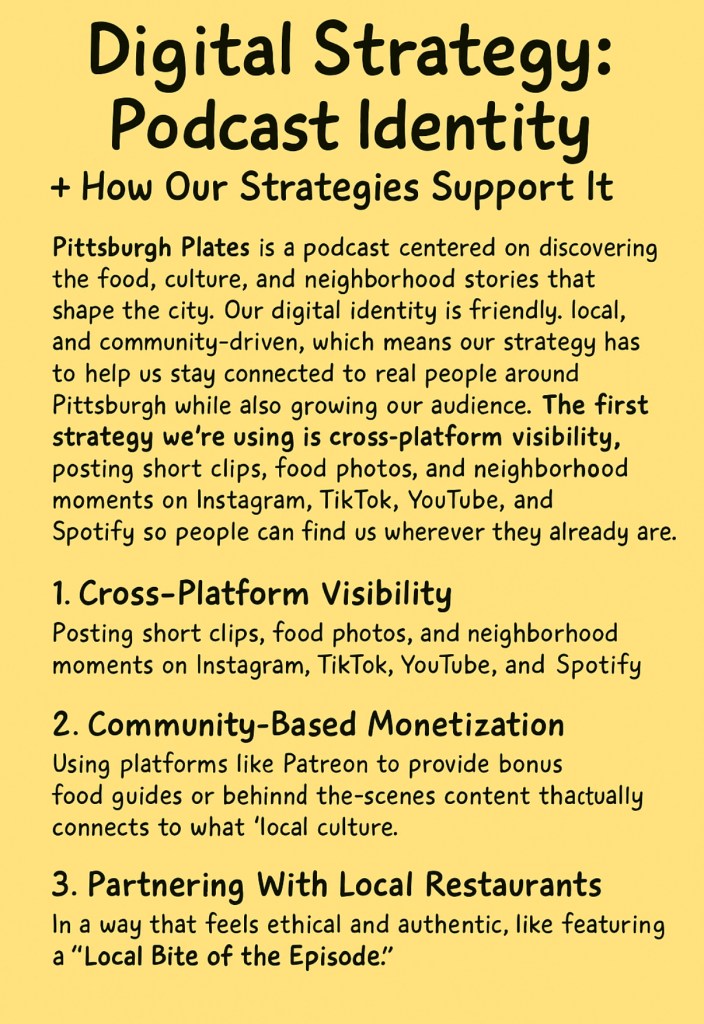
  • Pittsburgh Plates is a podcast that celebrates the food, the people, and the hidden cultural stories of Pittsburgh that make it home. Each episode digs into the local flavors-like Polish heritage foods or the city’s emerging coffee culture-while highlighting the communities behind them. The digital strategies I chose align directly with this purpose. By using cross-platform sharing helps reach locals where they already hang out online, community-based monetization allows listeners to support the show in ways that feel meaningful, and partnering with local restaurants or cafés strengthens the neighborhood connections our podcast is built on. Together, these strategies help Pittsburgh Plates grow while staying authentic, community-focused, and rooted in the real people and places we feature.


  •  

    Jessica Abel’s “Make It Work” shows the real juggling between creative passion and practical survival. One of the strongest strategies she introduces is designing a “minimum viable output,” which encourages creators to choose formats and schedules they can actually sustain without burning out. She also stresses diversified income, such as workshops, memberships, or bonus content, as a way to build stability for the creators without compromising their artistic goals. These strategies are effective because they put longevity before pressure, making space for creativity instead of squeezing it.

    For Pittsburgh Plates, Abel’s approach is really relevant. Our show can stay manageable by keeping episodes focused and sticking to a realistic posting rhythm. A future Patreon with curated restaurant lists or bonus stories could provide light meaningful value without overwhelming us. Abel’s storytelling choices also stand out.  She works between narrative moments, personal reflection, and practical guidance in a way that makes the episode emotionally engaging and structurally clear. This mix of honesty and craft is something we hope to bring into our own storytelling about food, culture, and community in Pittsburgh.

  • In understanding how podcasts expand beyond audio, I’ve looked at the digital ecosystems of This American Life, The Kitchen Sisters, and Sporkful. These shows build rich, interconnected spaces that help audiences go deeper into the stories.

    Where They Live Online

    • Websites with transcripts, photos, and archives

    • Instagram/TikTok for behind-the-scenes clips and visuals

    • Newsletters to offer extra insights and updates

    • Patreon/Substack w/exclusive content

    How They Extend Their Stories

    • Visual context that complements the episode

    • Community engagement: comments, polls

    • Bonus interviews, maps, recommendations, or recipes

    • Flexible access points for new listeners

    What Inspires Pittsburgh Plates

    • Sharing food pictures and short videos. Things like publishing neighborhood restaurant guides • Creating a simple home base like a Linktree or a  website, and this could offer  bonus cultural notes or recipes

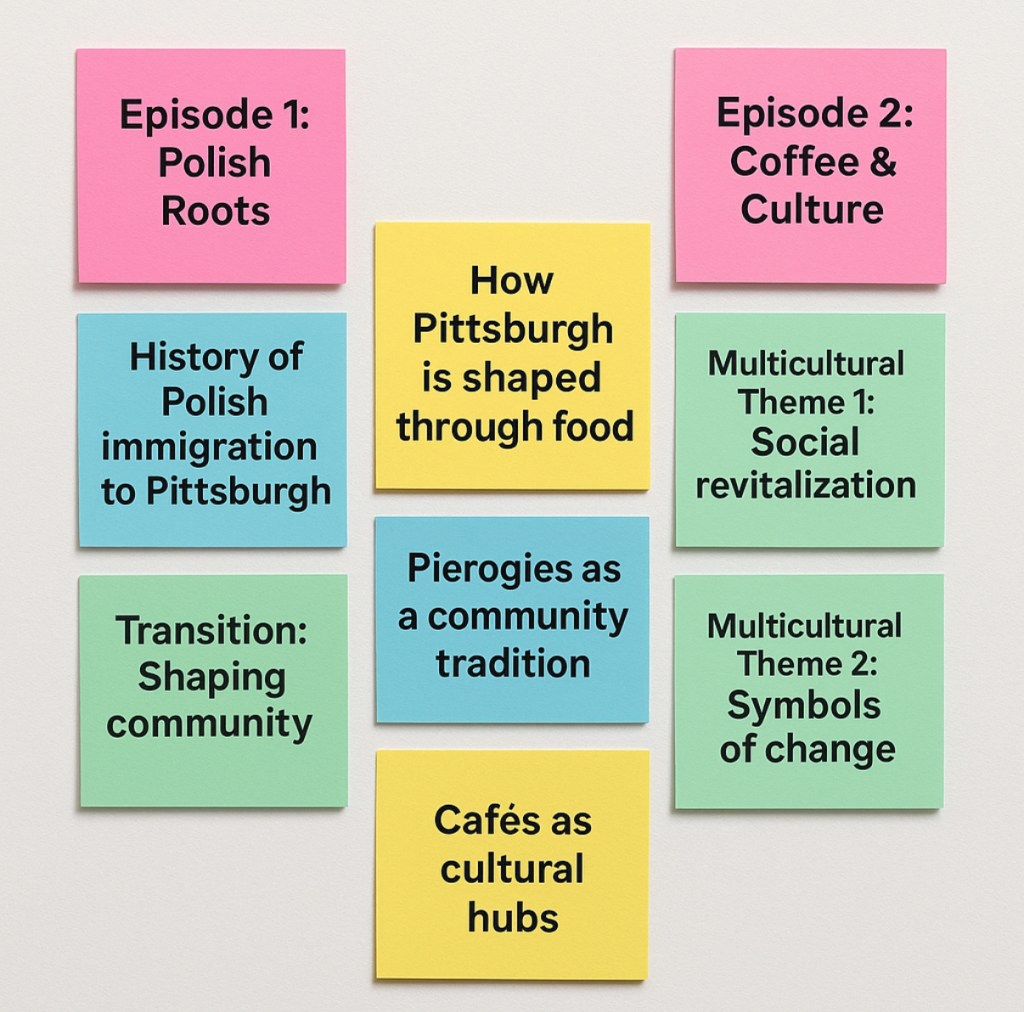
  • Using the Content Composer in Revision Mode allowed me to really see how my first two episodes connect and what direction my podcast season is taking. Initially, the episodes on Polish food and on Coffee & Culture felt very different from each other. But once I laid all of that out on the digital post-its, I realized they share the same deeper purpose. Both show how the food and drink in Pittsburgh tell stories about identity, heritage, and community. Seeing this visually made the season feel much more cohesive.

    The map also showed me that each episode explores a balance between tradition and change. The Polish food episode explores how traditions are preserved through recipes and family histories, while the coffee one turns cafés into symbols of cultural blending, creativity, and sometimes gentrification. Noticing this pattern helped me understand that my season is really about how everyday food spaces reflect the city’s past and future.

    Several new ideas also emerged. I saw opportunities for future episodes on immigrant-owned bakeries, neighborhood markets, or local specialty foods. These are topics that naturally fit my core theme. The Composer assignment really helped me to realize that my podcast is not about what people eat or drink, but rather about how those spaces shape identity and belonging in Pittsburgh.

  • A part of BBC’s Between the Ears series is the episode “A Cow a Day”.In this episode producer and poet Pejk Malinovski follows a single cow through the streets of Varanasi,India, from morning till night. The episode showcases the question of “what happens when we slow down enough to see, and hear the world from another creature’s perspective? The story begins with the soft noise of city traffic, distant chanting from temples, and gentle clinking of cow bells. From the start, the listener is transported to the world through texture and sound.

    The storytelling approach used for this episode is very observational and poetic. Malinovski has used the sound for empathy, like when he includes footsteps, bicycle bells, and snippets of conversation to tell the story of coexistence between humans and animals. Through the episode the listener can almost feel like there meditatively floating with the cow, following the rhythm rather than just the words. One sound that striked at me was when the cow wandered into the market and you could hear all the chaotic beauty of the city. This sounds included the sudden layering of horns, sellers shouting, and the cows slow heavy breathing.

    The episode makes the listener feel calm and is able to show us that the impact of work is in the slowing of time. It really asks us to listen in a different way to the story, not just for surface level of the plot, but simply to be present. The story is centered around culture and place. The cow, which is very sacred in Hindu tradition, moves freely through the streets where spirtual life and daily routines are met. By following her journey, us as listeners are able to hear the heartbeat of Varansi itself. A Cow a Day shows us that storytelling is not merely about just the words, its about paying deep attention to details and truly listening.

  • In this episode, what truly got my attention the most as a listener was simply how alive and vivid the landscape was sonically. I enjoyed the clip-clops of the horse hooves, the subtle crunches of the gravel road, and the soft blowing of the wind, which really encapsulated the moods of the Appalachian Mountains. I listened to the narrator’s calm and gentle voice combining with the tone of the episode, and enabling me to feel the isolation of the mountains and the determination of the women who traveled through them. One thing that really caught my attention was when the librarian discussed taking books “like treasure” through rain and mud. You could feel the enthusiasm in her voice and the storm in the background. The silence in the episode was used so strategically. It made me focus on her true emotion and made me feel how important their work was. Another point in the episode where culture was shown was when the people spoke in their own Appalachian dialects. They spoke so proudly and so clearly, and it had such a sense of identity and community to it. Their language spoke volumes about who they were. They were such hardworking, loving, and country-driven people. I liked how the show had the women share their own stories instead of someone else, like a narrator, recounting their stories, which made it all more real and interesting. This story shows how language and culture are so intertwined. I think the sound effects were one of the podcast’s strongest elements. The way it incorporated real sounds, like horses and footsteps, with the soft and subtle background music really made the story come alive. If I were involved in the production, I would have added almost imperceptible longer pauses after emotional segments to give the listener a little more time to sit and process what had just been spoken. I learned from this episode how sound can make a story come alive and help to present culture in an honest and respectful way. The Kitchen Sisters showed how storytelling can honor a community and keep its voice alive.

  • Language has also been of interest to me as it is such a big part of how people identify themselves. Although I am only an English speaker myself, my father’s side of the family is Polish, and this has definitely influenced my thoughts on culture and identity. As we worked on our initial podcast episode about Polish food and culture in Pittsburgh, I was amazed at how traditions manage to sustain a sense of belonging from one generation to the next. Talking about foods like pierogi, I realized that food can be a language in its own right. It says so much about history, migration, and familial pride. As Cultural Humility: People, Principles, and Practices says, learning culture is not so much learning facts, but it is listening to people’s stories and honoring how they tell them.

    In our second episode, “Coffee beyond the Bean,” I got a chance to interview and talk with Saurin Nanavati. Saurin is the founder of Ethos Agriculture. He has years of experience managing sustainable coffee and cocoa programs across twenty countries. Through talking with him, I learned how such a common thing as coffee can be filled with cultural meaning. I’d never thought of coffee as more than a daily habit, while for Saurin, it was a ritual of hospitality and relationship. Hearing that made me more aware of my own assumptions and how easily we can think we already “get” another culture. It also helped me see the difference between cultural competence (having some knowledge) and cultural humility (being open, curious, and willing to keep on learning). That principle really changed the way I interviewed since I actively listened more instead of trying to interpret everything through the lens of my own experience.

    Podcasting has also helped me to understand that cross-cultural communication is not just about interest; it’s about reflection. I sometimes assume that others have the same ways of showing respect or being comfortable that I have, and that’s not always true. Practicing cultural humility is a matter of slowing down, asking questions, and being okay with the fact that I’ll never entirely understand another’s experience, and that’s alright. It’s Cultural Humility: People, Principles, and Practices, talking about lifelong learning and self-reflection, and I understand now more than ever. From our podcasting assignments, I’ve learned that embracing diversity is not so much about being an expert. It’s truly about being curious and learning alongside others as we move forward.

  • It was both difficult and gratifying to edit the “ode” audio file in audacity. The hardest part was removing glitches in the narration. Especially with the amount of coughs and repeats the man had. Several careful cuts and playbacks were needed to make transitions between lines smooth and natural.

    Layering ambient sounds was also a challenge for me. I couldn’t figure out how to download the music files and add it into the recording. But I think It could of made the recording sound better, giving it a piece of emotional depth.

    One technique I’ll definitely use in the future projects is balancing EQ and volume levels across tracks. I learned that even small changes in loudness can create major diffrences in mood and clarity. Overall, this exercise showed me how to combine technical precision with creative sound design to bring a reading to life.

  • Arming our food and culture podcast in Pittsburgh provided me with a real awareness of just how much language is tied into identity. When we interviewed the proprietor of the Polish restaurant, she boasted about her family recipes and had a tendency to mix English and Polish words together. It made me hyper-sensitive to how language can get caught up in history and feeling. Speaking with Saurin for our second episode about coffee showed me this same thing too—how simple, plain language is employed in establishing a sense of belonging and of community.
    These interviews also caused me to reflect on how frequently individuals misjudge cultures. Individuals believe that Polish cuisine is merely “heavier” or “outdated,” but the manner in which she described modifying recipes from generations past completely changed my perspective. I recall the manner in which individuals make assumptions concerning my own culture as well, particularly through language. I discovered that words can either build bridges or walls, depending on their usage.
    I was nervous at first about saying something incorrect in interviews, but learning Cultural Humility with Dr. Vivian Chavez made me feel at ease and allowed me to listen more openly. Instead of trying to be perfect, I focused on curiosity and respect. This shifted added so much richness to our conversations. I realized that culture cannot be taught as facts. it’s empathy and willingness to learn in perpetuity.